Picture this, you’re reviewing a contract drafted with AI help. It looks perfect until a colleague spots a case citation that doesn’t exist. Or you’re screening candidates with an AI tool that seems efficient, until someone points out it quietly favors certain schools and neighborhoods. Or you’re using a chatbot for customer support, and it promises something your company can’t deliver.
These aren’t hypotheticals. They’re happening now, in real teams, with real consequences.
AI can write, analyze, and decide faster than any of us. But speed without guardrails is how mistakes scale. And right now, we’re in a moment where the technology is racing ahead of our habits, our training, and in many places, our rules
The Gap we are in
Companies poured a record $252.3 billion into AI in 2024, with $33.9 billion going just to generative AI. At the same time, documented AI safety incidents jumped 56% in one year, and by early 2026 the AI Incident Database tracks well over 1,300 real‑world cases.
Yet only about one in five organizations says it has a clear AI strategy. Most teams are experimenting with powerful tools, but without a shared plan for using them safely. Meanwhile, rules are tightening: from August 2026, the EU AI Act starts enforcing transparency and serious‑incident reporting, with high‑risk obligations phasing in through 2027–2028.
Note
If you’ve ever felt a twinge of worry when an AI output looked “too good,” you’re not being paranoid. You’re noticing the gap between what AI can do and how carefully we’re using it.
What Responsible AI actually looks like?
Note
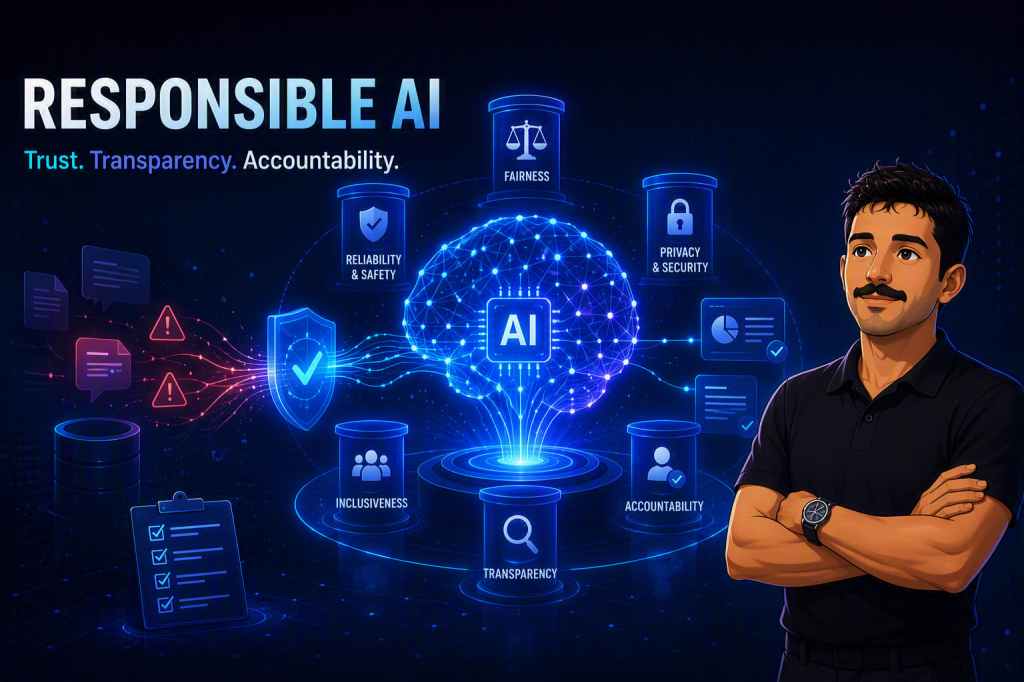
Microsoft’s Responsible AI courses on Microsoft Learn boil it down to six pillars that show up in everyday work.
You don’t need to memorize frameworks to use responsible AI. You just need a few clear habits. Microsoft’s Responsible AI courses on Microsoft Learn boil it down to six pillars that show up in everyday work:
- Fairness : Would this decision feel fair to everyone it affects?
- Reliability & safety : What happens if this goes wrong?
- Privacy & security : Are we exposing data we shouldn’t?
- Inclusiveness : Who might be left out or misunderstood by this system?
- Transparency : Would people be comfortable knowing AI was used here?
- Accountability : If something breaks, who owns it and how do we fix it?
Responsible AI feels like pausing before you trust an AI‑generated answer, checking one key fact manually, and being upfront with colleagues and customers when AI is involved. It means treating AI incidents the way you’d treat a security incident: log it, understand it, learn from it.
A simple way to start
You don’t need a new title or a six‑month program, just a small shift.
1. Spend 20–30 minutes on Microsoft Learn
Read the short piece “What is Responsible AI?” It walks through the six pillars above with real examples of how they show up in projects. If you have a bit more time, skim the summary of Microsoft’s Responsible AI Standard to see how a large organization turns those ideas into day‑to‑day requirements.
2. Add one habit to your next AI task
The next time you use AI to draft, analyze, or decide:
- – Ask: “Who could be harmed if this goes wrong?”
- – Check one key fact or assumption manually.
- – Note what you used, how you used it, and what you checked.
- – That tiny bit of friction often catches big issues before they spread.
3. Try one short course On LinkedIn Learning, courses like Responsible AI: Principles and Practical Applications walk you through realistic scenarios: spotting bias, dealing with hallucinations, and setting up simple governance steps you can actually use.
4. Start a conversation, not a policy Share what you learn with your team. Forward the Microsoft Learn page, mention the LinkedIn course, and suggest a quick chat: “How are we using AI today, and where do we feel uneasy?”
Note
The next time you use AI to draft, analyze, or decide, check one key fact manually and note what you used and how. That tiny bit of friction often catches big issues before they spread.
Note
Small steps like reading one Microsoft Learn page and trying one short course can shift how your whole team uses AI—fewer embarrassing mistakes, more trust, and more confidence scaling beyond pilots.
Why this is on all of us?
AI won’t be governed by a single team, law, or framework. It will be shaped by millions of small choices: which tool to use, which output to trust, which warning to ignore, which conversation to have.
Every model reflects human decisions—about data, objectives, and trade‑offs. Every incident traces back to someone assuming the technology would “just work.” And every improvement starts with someone deciding that responsible use is part of their job, not someone else’s.
Note
If you’ve ever felt uneasy about an AI system, that feeling is data. It’s a signal that something important is at stake.
Start where you are: read the Microsoft Learn overview, try one short Responsible AI course, and bring those ideas into your next project. That’s how we turn a vague ideal into something that actually protects people and the promise of AI itself.
Ready to make AI Safer in your team?
Microsoft Learn : What is Responsible AI?
Microsoft : Responsible AI Standard (overview & transparency) LinkedIn Learning : Responsible AI: Principles and Practical Applications Stanford HAI : 2025 AI Index ReportAI Incident Database : Incident reports 2025–2026